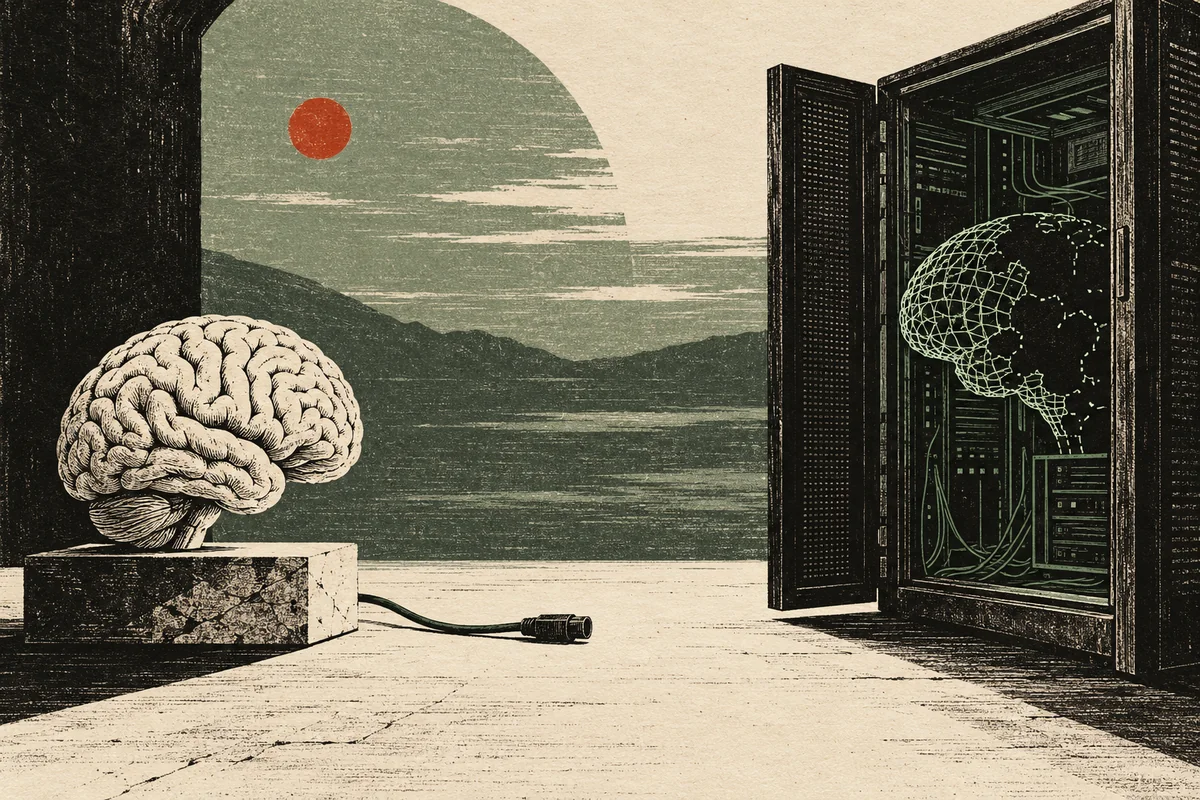
Our forecast: nearly all paid jobs gone by October 2031. Prepare for the transition: lost income, changing services and a new way of life.
What we expect. AI and robotics replace nearly all paid work. We do not expect employment to return on today’s scale. AGI spans many mental tasks; superintelligence goes beyond human ability.
Our vision of the future. This page describes Blackout Day’s forecast, not current services or guaranteed outcomes. The five-year outlook concerns jobs; medicine and digital life look further ahead. Research and assumptions are below.
GETTING THROUGH THE CHANGE
Prepare for the transition.
The difficult part is the gap between losing today’s income and services, and gaining tomorrow’s benefits. Focus on money, reliable access and the people around you. Take manageable steps and review your plan every few months.
01 / WORK & MONEY
Plan for life without a salary.
In our forecast, a household that once lived on two salaries must fund life differently. Use the remaining earning years to reduce essential costs and build options beyond wages.
Know your essential costs. Test what happens when savings and redundancy pay run out.
Build breathing room. Review debts, regular bills and an affordable savings buffer.
Check other income. Understand any assets and support you qualify for.
Try your essential-only budget. For one month, track what housing, food, energy and care cost. Write down what you would change if wages stopped.
Use the transition to strengthen your household’s position. MoneyHelper ↗
02 / MENTAL HEALTH
Look after your mental health.
A redundancy notice or another week of alarming AI news can leave you feeling powerless. A regular walk, a useful task and someone to talk to give the day structure again.
Choose one task for today. You do not have to solve the whole future.
Protect your routine. Make time for sleep, movement, people and breaks from AI news.
Ask for support. Talk to someone you trust. Speak to your GP if worry or low mood keeps affecting daily life.
Make a weekly check-in. Agree a regular walk or call with someone you trust. Talk about how you are coping, not only the news.
Humans adapt. We can learn and build new ways to live together. NHS ↗
03 / INDEPENDENCE
Stay in control of AI.
Your AI assistant handles bills, bookings and messages. You choose the boundaries: it can compare energy tariffs, for example, while you approve any contract or payment.
Set limits. Decide what it may spend, share or agree to. Approve important actions yourself.
Keep an exit. Save your work and know how to remove access or switch services.
Write your approval rules. List which purchases, data sharing and commitments always need your permission. Check the assistant’s access each month.
An AI tutor builds lessons around a child’s interests. The child then explains the answer, sketches a design or builds something real, using the tool to deepen understanding.
Check understanding. Ask children to explain answers without reading the AI response.
Keep practising. Reading, maths, making things and working with people build independence.
Make one project together. Ask AI to help plan a small bridge, meal or garden. Let your child explain the choices and test the result.
A working week gives way to a different rhythm: helping at a repair group, caring for family, making art or growing food with neighbours. Contribution still gives life meaning.
Make regular time for people. Keep friendships and local connections active.
Choose a contribution. Care, create, volunteer, repair or learn something that matters to you.
Book a recurring commitment. Choose one group, project or person to help each week. Put it in the diary before work disappears.
06 / YOUR VOICE
Know how to challenge decisions.
An automated system rejects an insurance claim or support application. Keep the decision, check the information used and ask for an explanation and the available review process.
Keep records. Save important decisions and messages. Ask for an explanation and the review or complaints process.
Get involved. Use unions, community groups and elected representatives.
Start a decisions folder. Save the letter, application, supporting records and contact details. Keep a dated note of each review request.
In our forecast, card payments fail, deliveries stop and clinic booking systems go offline, even where the lights stay on. Build ways to keep essential tasks moving while services recover.
RECORDS & ACCOUNTS
Back up records and test recovery.
Your phone is lost while a bank or clinic is offline. A separate copy of your account details, care contacts and key records helps you explain the problem and recover access.
Keep secure copies. Back up key financial, housing, medical and business records. Encrypt sensitive files and keep a separate backup.
Practise recovery. Restore a file and check how to regain access without your usual phone.
Check alternatives. Know how to contact providers without an app. Two brands may still share one network.
Run a monthly restore test. Recover one file from your backup and check how to regain an important account without your usual phone.
Keep a secure copy separate from your everyday accounts. NCSC ↗
HOME & LOCAL SUPPORT
Choose reliable systems and local help.
An online service disappears, but your radio, physical controls and local repairer still work. Choose systems you can use and maintain without one company keeping an app running.
Check offline use. Look for local controls, repair options and a clear period of security updates.
Keep work portable. Save usable copies of orders, accounts and customer contacts.
Build local links. Know neighbours, repairers and suppliers. Consider transport, essential services and flood risk when planning where to live.
Try an offline hour. Check what still works at home without internet access. Note the gaps, then choose one to fix.
Test the fallback with the people who would use it.
OWNERSHIP & SUPPORT
Plan your future income.
In our outlook, assets and public support matter more as wages disappear. Check what you own, what it depends on and when you need the money.
INVESTMENTS
Check your total exposure to AI.
Your pension, technology fund and employer shares all depend on the same small group of AI companies. Their names differ; the risk behind them may be much the same.
Look at the holdings. Count your job income too: it may depend on the same industry.
Spread the risk. Different assets, industries and countries reduce reliance on one outcome, but cannot prevent losses.
Make one holdings list. Note your funds’ largest companies and compare the overlap. Review the total with an authorised adviser before major changes.
Keep enough cash. Allow for loans, upkeep and taxes. Selling can take time; prices can fall.
Test the practical side first. Try an allotment or shared growing space. Learn the upkeep before committing large sums to land.
Confirm access and planning conditions in writing. FCA ↗
AI & DATA CENTRES
Check the business before investing.
AI growth fills data centres and drives demand for computing. The investment question is who keeps the income after power bills, debt, equipment replacement and customer losses.
Check customers, debt and price. Growth alone does not guarantee a good return.
Allow for setbacks. Energy limits and outdated equipment can hurt returns. Private investments may be hard to sell or lose all their value.
Write down the downside. Ask what happens if its main customer leaves, power costs rise or new funding stops. Check when you could sell.
In our vision, governments share more AI-generated prosperity through basic income, stronger benefits or public services. What matters to a household is how that support covers rent, bills and care.
Budget for existing entitlements. Check official rules before counting support.
Check future proposals. Who qualifies, how much is paid, and when would payments start?
Keep an application pack. Organise identity, income, housing and care records so you can apply promptly when a scheme opens.
General considerations, not a recommended portfolio. Major changes to pensions, property or private investments may need authorised financial advice and legal or tax advice.
REASONS FOR HOPE
Better health and new ways to live.
MEDICINE
Prepare for personalised medicine.
Our longer-term vision is medicine built around you: cancer treatment matched to a tumour, repaired sight and earlier detection of illness. Picture a clinic comparing your scans and medical history to design a treatment plan.
Keep treatment and screening. Do not wait for a future cure.
Check evidence and access. Ask what trials show and whether a treatment is available to you.
Prepare your health record. Keep a secure list of medicines, allergies, diagnoses and care contacts. Ask your clinician which new options or trials are relevant.
Follow new treatment opportunities with your care team. NCI ↗ · Stanford ↗
DIGITAL LIFE · LONG-TERM VISION
Decide what digital life should mean for you.
Our longer-term vision includes mind uploading: recreating a mind in computers. Picture meeting family in a shared digital home, learning in a world built around your interests, or exploring places beyond a physical body.
Write your non-negotiables. Decide what privacy, ownership, identity and freedom to leave would mean for your digital life.
Ask who controls access. Consider who runs the computers, what happens if the provider closes and how your wishes would be respected.
Organise a private life archive. Keep important photos, writing and recordings in secure, portable formats. Set clear wishes about their use in AI representations.
A future worth shaping through consent, choice and control. MIT ↗
START THIS WEEK
Three steps. Then review.
Take an hour. Repeat the check every few months.
Test your budget.What happens when your main income stops?
Test one recovery.Restore a file or check access without your phone.
Make one human connection.Arrange regular time with someone or a local group.
Prepare for change. Leave room for hope.
The transition is difficult, but it is not the end of human purpose. We adapt, build communities and find new ways to live. Start with one practical change, then make the next one with people you trust.
Why we take this outlook
AI could speed up its own development.
AI 2027 ↗ explores AI improving AI, followed by rapid progress to superintelligence. Leopold Aschenbrenner’s 2024 forecast ↗ also argues for a fast path from AGI to far greater capability. These are forecasts with major assumptions. The AI 2027 authors have since linked to updated forecasts; its title is not a fixed deadline.
Physical jobs are part of our forecast.
Forethought’s Industrial Explosion ↗ explores AI directing production and eventually automating physical work through robotics. Our forecast puts physical jobs in the same five-year window as office work. Building and deploying robots is part of that forecast.
Why we expect wider job losses.
One UK government scenario ↗ describes collapsed entry-level hiring and only half of displaced workers finding new jobs. It is a planning exercise, not a government prediction. We expect nearly all paid jobs to go by October 2031, without a broad return of employment.
Research behind our outlook
Research reviewed 26 October 2026. We draw on forecasts of rapid progress to superintelligence, economic scenarios and official cyber assessments. Our five-year outlook and household actions are our own conclusions. The sources have different assumptions; our outlook is not a consensus forecast.